Startup Law Lab. Volume VII: “Employee Participation and Retention Done Right”
The leap from founder to employer is a crucial milestone for any startup. When is the right time for the first hire? Which employment law fundamentals must be observed? And how can employee participation schemes be used as a strategic tool for talent acquisition?
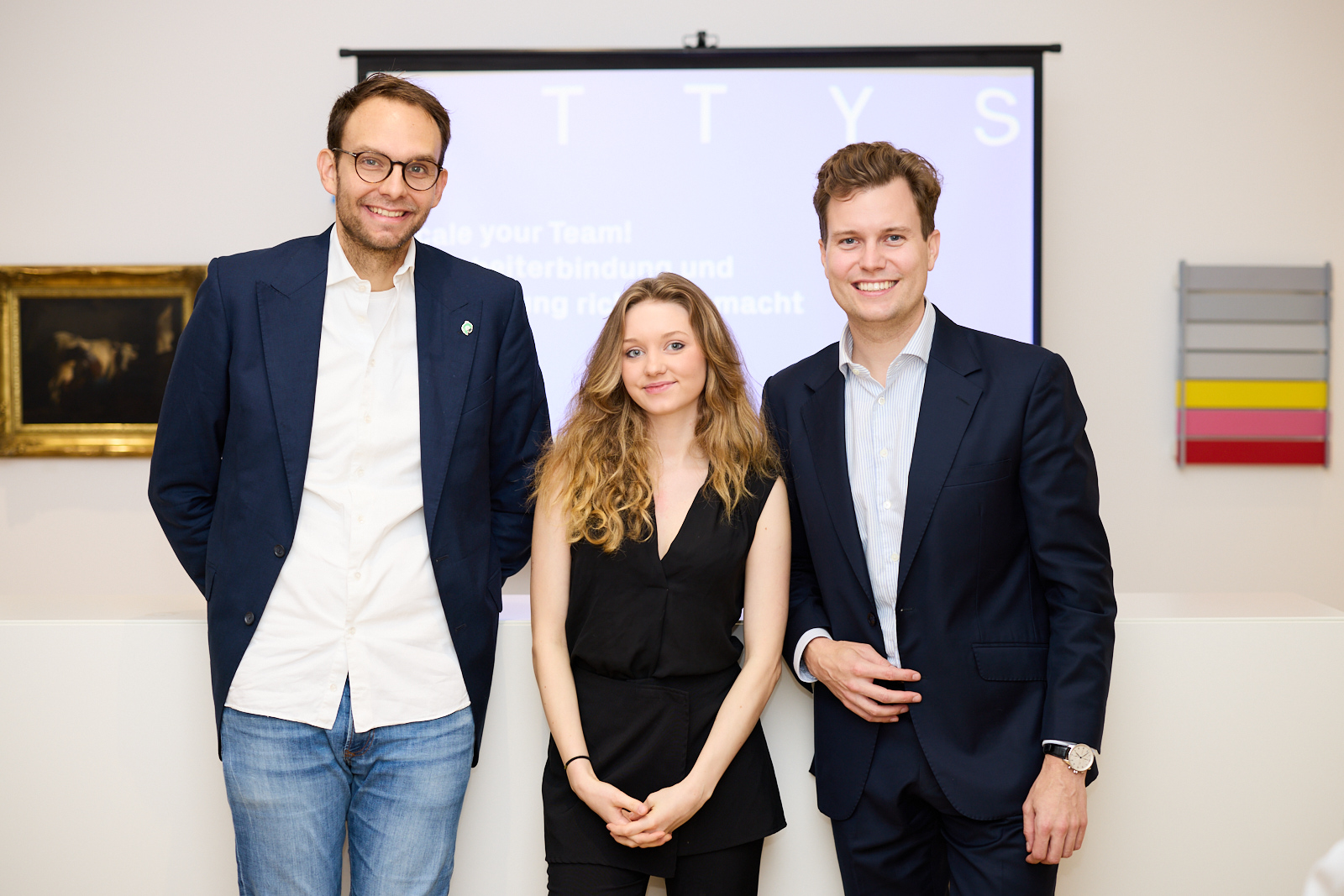
On October 23, 2025, we explored these questions together with Nicolas Vorsteher (founder of chatlyn) and Dr. Christoph Ludvik (Partner at ATTYS Rechtsanwälte). The evening was moderated by Kambis Kohansal-Vajargah, Head of the Startup Service at the Austrian Federal Economic Chamber.
Nicolas Vorsteher shared his practical experience in building chatlyn – a platform that unifies all communication channels in a central inbox. Dr. Christoph Ludvik explained the legal framework: from employment law fundamentals and the four main models of employee participation to tax optimization possibilities.
Cost of Employment: A Critical Factor
The total cost of an employee significantly exceeds the gross salary. For salaried employees and workers, additional employer contributions of approximately 29.50% apply (social security, employer contribution, municipal tax, etc.). For independent contractors, this rate is reduced to about 18.07%. This cost structure explains why many startups seek alternative incentive models that are less liquidity-intensive – this is where employee participation comes into play.
Employee Participation: The Four Main Models Compared
For startups with limited budgets, employee participation is a central instrument for talent acquisition. The choice of the right model depends on corporate law, social security law, and tax law considerations.
- Genuine Share: Participation in the share capital with voting rights and claim to dividends. Requires a notarial deed. Tax benefits under § 67a EStG or § 3 para 1 Z 15 lit b EStG (up to EUR 3,000) possible. Current profits/Exit: 27.5% capital gains tax (KESt).
- Substance Participation Right (Substanzgenussrecht): No capital participation, no voting rights, but dividend-dependent distributions. No formal requirements. Tax-wise similar to a genuine share.
- Non-Genuine Convertible Bond (UWA/FlexCo): Restricted right of consent without full voting rights. Written form required, no notarial certification. Tax-wise identical to the aforementioned models.
- Phantom Stocks/Virtual Shares: No substantive participation. Administratively simple, but tax-wise unfavorable due to progressive wage taxation. Conversion into favored participations under § 67a EStG possible between December 1, 2024, and December 31, 2025.
Holistic Employee Retention: More Than Just Participation
As Nicolas Vorsteher emphasized, financial participation is only one element of a comprehensive retention strategy. Startups score points through:
- Cultural Measures: Strong vision and purpose, open communication through regular all-hands meetings, flat hierarchies with personal responsibility.
- Financial Incentives: In addition to equity, performance-based bonuses and competitive, sustainable salaries.
- Development Opportunities: Steeper learning curves, budgets for further training, and transparent career paths.
- Work Environment: Flexible working models (home office, remote), modern work tools, and startup-typical benefits.
- Social Connection: Team-building events, culture of recognition, and mentoring programs.
Our Recommendations at a Glance
- Professionalize early: Seek employment law advice before hiring your first employees.
- Carefully choose the form of employment: Classification as an employee, independent contractor, or self-employed person has significant cost and legal consequences.
- Strategically select the participation model: For most startups, UWA/FlexCo solutions or substance participation rights offer the best balance between control, tax optimization, and complexity.
- Utilize tax benefits: § 67a EStG and the EUR 3,000 exemption limit under § 3 para 1 Z 15 lit b EStG can bring significant advantages.
- Create transparency: Communicate openly about participation models and anti-dilution protection. Lack of transparency creates mistrust.
- Think holistically: Employee retention arises from the combination of culture, development, flexibility, and emotional connection – not just financial incentives.
- Ensure legal compliance: Observe disclosure obligations under § 1157 ABGB (General Civil Code) and § 18 AngG (Employee Act).
- Investor-employee balance: Reconcile the interests of both sides.
Are you planning to build your team or implement a participation program?
With the seventh edition of the Startup Law Lab, we have shown that employee participation and retention is a complex interplay of employment law, corporate law, tax law, and corporate culture. The right strategy can make all the difference in the “war for talent.”
We support you in designing legally sound and tax-optimized participation programs – from the first hire to a successful exit. Contact us for a consultation or register for the next Startup Law Lab.